Posts built around cooking a dish.
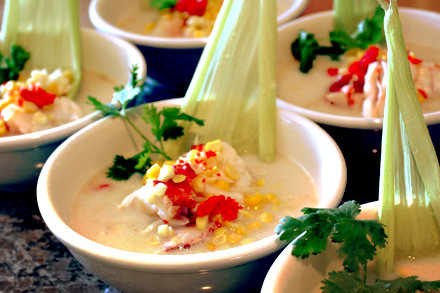
Every summer when the weather gets sultry my partner, Warren, who is a “Swamp Yankee” with family directly descended from the Mayflower Pilgrims, gets nostalgic and yearns to get in touch with his roots. This year is no exception and last week we spent an extended weekend in Provincetown to indulge in his nostalgia. Throughout our stay we drove around Southern New England and ate wonderful shore dinners and other scrumptious meals at restaurants all over Cape Cod. We gorged ourselves on fish and chips, lobster rolls, clam cakes, stuffed quahogs and fresh sweet corns. By Sunday I was lusting after the fresh seafood and local farm produce, and decided to make a shore dinner but gave each course an Asian twist.
Just south of Prospect Park in Brooklyn bounded by Church Avenue to the north, Coney Island Avenue to the west, Beverly Road to the south and the Q line subway track to the east is an oasis of Victorian residences. Known as Prospect Park South the area was built around the turn of the 20th century for discriminating New Yorkers looking for a suburban lifestyle. Our friends Lauren and Maureen fell in love with one of these houses when they were hunting for a home about a decade ago. It was a huge rambling grey house in need of repair with an overgrown garden in the back. Although they knew there was incredible potential for the house, it wasn’t until they started clearing the garden that they discovered the real treasure: raspberry brambles.
Two weeks ago I went to a Dongbei (or Northeastern China) restaurant in Flushing for lunch with a group of Chinese food enthusiasts. I glanced through the menu, but like many seasoned Chinese diners I asked the owner if they had any special seasonal dishes from the kitchen. As it turned out they had young tender garlic scapes, which are the stalks of garlic blossom, and she suggested we ordered them stir-fried with pork slices. I was thrilled to know they’re still available during this late in the season.
Arriving in America in the 1970’s I was introduced to a few American Chinese restaurants that still served chop suey and chow mein. I remembered that one particular item on the menu aroused my curiosity. It was Moo Goo Gai Pan. Expecting a dish with mushrooms and chicken I ordered it. Imagine my horror when the dish arrived displaying a rainbow array of vegetables with pork slices. There was no Moo Goo. There was no Gai Pan.

In Ba Jin’s (巴金) epic Chinese literary trilogy: Family , Spring
 and Autumn
 (家,春,秋), the author describes the life of a Chinese aristocratic family during the final years of the feudalistic Qing dynasty. It was a tumultuous time in which the family members had to negotiate changing political landscape as dynastic rule disintegrated, as well as the family’s own struggle between generations over changing values and aspirations. Ba Jin was a great observer and narrator of a China struggling within and without while falling into chaos at the beginning of the twentieth century. Among all the confusions and upheaval, there is one single constant and that is the communal family meal.
Whether it was an elaborate sumptuous spread of the upper class or a meager bowl of porridge of the poor, sharing communal meals was a social ritual. Families gathered for special celebrations and revolutionaries gathered for clandestine dinner meetings. These meals were not always happy and agreeable occasions. Tensions among family members often boiled over during them. But they gathered and shared their food nevertheless.
(more…)
It was in high school when my two passions of science and food intersected in a physics lab. I was a student at the Chinese High School in Singapore, and the assignment was to take fresh duck eggs and immerse them in salt water. Through osmosis the brine would seep into the eggs and we’d measure the salt content over time. Although the science was fun, what I remember most was the delicious eggs that I took home to cook!
Like many home cooks I love to collect all kinds of cooking utensils, appliances, cookware and tableware. I own a strawberry huller, fish poacher, taco frying tongs and artichoke plates. Then after using them once or twice they’re usually banished deep in a drawer or at the back of a kitchen cabinet, where they’re undiscovered for years. But there is one curious looking specialty clay pot, with a steam spout in the middle, that I use regularly for making the most delicious chicken soup. It is a Yunnan (雲南) steam clay pot (汽鍋).
During the winter months for the last two years I started noticing fresh frozen abalones for sale in New York City’s Chinatown. A few fishmongers display mounds of these large solidly frozen mollusks. I was curious where these abalones come from. Unfortunately most of the shopkeepers were not able to enlighten me. However one person suggested Australia, which is plausible since abalone farming has become very successful there. This success has made abalone a sustainable ingredient. So this year when I was planning our Chinese New Year family celebration I did not hesitate to include some of these beautiful abalones for the Hakka dish DaPenCai.
A good friend took us to an elegant Buddhist vegetarian restaurant for dinner in Hong Kong last summer. It was a spectacular meal. Not only was every dish distinctive and delicious, but innovative and sophisticated as well. There was winter melon soup with mixed vegetables, vegetarian soup dumplings, stir-fried tofu skins with seaweed and multigrain steamed rice. But the most memorable dish of all was the salt and pepper crisp-fried enoki mushrooms. When Mel from Gourmet Fury once again asked me to enter the mushrooms challenge of Beet ‘n Squash YOU! I decided to recreate this dish with a twist.
 Once the yearend holidays and New Year craziness are over everyone begins to look to Valentine’s Day. Lovers are not the only ones wooing their partners. Marketers, the media and even bloggers take this opportunity to court their customers and readers. Chocolate companies package their products in red and white, and the media and blogs are full of advices and suggestions on how to charm your lovers. There are articles on how to make your lady or man happy, and how to celebrate the day as a single person. Not to be outdone I’m also going to give you advice on how to create an impressive dish for that Valentine’s Day dinner.