Posts built around cooking a dish.
When I lived there during much of the 1970’s, Boston was not known for its culinary prowess. It was way before Todd English or Barbara Lynch appeared on the scene. The plain, or rather bland, New England cooking tradition offered little stimulation for my Asian palate that’s used to a spicy array of flavors. I couldn’t quite adjust to the pure taste of the food. That is until I discovered the fiddlehead fern, a native delicacy. It completely changed my view of the New England cooking approach. It is not about creating flavors for the sake of flavors, but rather to maximize the flavor of what’s already in nature.
Song Jiang (宋江), who is an outlaw during the Song dynasty (宋朝) around eleventh century, is also a heroic character in the classic Chinese novel Water Margin (水滸傳) written around the fourteenth century. In the novel he is exiled to Jiang Zhou (江州) after being convicted for a murder. Along with two bailiffs they board a hired river ferry which, unbeknownst to them, is operated by a pirate. Once they reach the middle of the river the pirate demands that they turn over their possessions and choose “shaved noodles” (板刀麵) or “wonton” (餛飩) for their last meal. Upon further clarification the pirate explains they can either be killed under his machete like dough being shaved into noodles or they can kill themselves by jumping into the river like wonton in a soup. Such is the poetic macabre image of wonton in one of the most beloved literary works of ancient China.
For the first century after the introduction of Chinese food to America by the first immigrants to California in the 1850’s, Cantonese cuisine reigned supreme. It was the most commonly served food in Chinese restaurants. “Mandarin” cooking, which became the jargon for anything non-Cantonese, appeared in the late 1960’s. Still most menus were made up of familiar soy sauce-based non-spicy items. Then in the mid 1960s Shun Lee Dynasty opened in the east side of Manhattan and started serving Sichuan influenced dishes. In 1969, after receiving four stars from Craig Claiborne of The New York Times, the public thronged to the restaurant to sample this new spicy cooking of China.
Also known as the Spring Festival, Chinese New Year marks the beginning of the spring solar term in the Chinese calendar. In spite of the name for the festival we are still in the coldest period of the year. So it is appropriate that during this time of year we consume many of the foods preserved after the autumn harvest and hunting season during the twelfth month of the previous year.
Since the Zhou Dynasty (周朝 about 3,000 years ago) the twelfth month of the Chinese calendar has been designated as a time for ritual sacrifice to honor the gods and ancestors. This ritual is known as “laji” (臘祭). Animals were hunted for offerings, and the meat consumed during the ceremony. Over time preservation techniques were developed to conserve the leftovers for winter consumption. One curing technique known as “la” (臘) consists of salting and drying of the meat. This brings me to the February challenge to make cured pork belly or bacon for Charcutepalooza.
In spite of the hazy smog that has become the norm in China’s polluted cities, all but one day of my recent trip to Chengdu (成都), the capital of Sichuan province, was clear and bright. I took full advantage of the good weather and explored many of its vibrant neighborhoods on foot. Living up to the city’s reputation as the snacking capital of China, I found a myriad of street vendors selling noodles, dumplings, fried snacks and other local delights. Much of these have been glorified in guidebooks, travel articles and cookbooks. What is not commonly known, however, is the struggle these vendors face in dealing with the authority.
When it comes to serving Thanksgiving dinner in our household there is only one menu: Warren’s mom’s. I’ve made the same New England Thanksgiving dinner for more than twenty years. The celebration always starts with assorted homemade pickles and relishes, and basketful of piping hot Parker House rolls. Then follows roast turkey with oyster stuffing accompanied by mashed potato, creamed peas and onions, and mashed winter squash and turnip. Finally the dinner ends with apple and pumpkin pies served with vanilla ice cream or Vermont cheddar cheese. As always there will be plenty of leftovers. Since Warren forbids me to alter the Thanksgiving feast, I’ve become very creative with leftovers. This year I decided to make Chinese pumpkin pancakes with the leftover pumpkin pulp from making the pie.
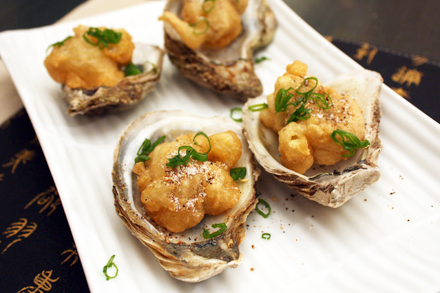
Browse through the aquariums at the seafood markets in Lei Yu Mun in Hong Kong, or at seafood restaurants in Guangzhou and Qingdao, you will find a plethora of shellfish display. There are abalones from Dalian, geoduck from Canada, scallops from Japan and oysters from America. All to satisfy the growing appetite for fresh seafood in China as the population becomes more affluent. Fortunately shellfish farming is one industry that is sustainable. Some shellfish farming, like oyster farming can even restore the environment. For this reason I’ve decided to highlight oysters for my rather late post in support of Jacqueline Church’s 4th Annual Teach a Man to Fish Sustainable Seafood Event.
A few years ago I happened to be in Shanghai during the Mid-Autumn Moon Festival. Normally during this time of year families come together for reunion dinners. But a few of my expatriate friends from Singapore and Malaysia, and I were posted in Shanghai without our families. So we gathered up a group and celebrated the festival at a Shanghainese restaurant. As we ordered our meal the waitress suggested we try some pork mooncakes. That was the first time I tasted a savory mooncake.
Think of sweet potatoes and you probably think of starchy roots candied or French-fried as side dishes. Or may be a dessert such as sweet potato pie to end a hearty meal. For many Chinese, however, sweet potato greens would also come to mind. These leaves are commonly used as a vegetable in Chinese home cooking. Sweet potato greens are just one out of multitude of Asian produce you can get in many Asian markets throughout New York City. On Labor Day (September 6th) you can learn how to identify and to cook this and other Asian vegetables at the first Asian Feastival in Flushing.