


Eggland’s Best Caramel Ginger Soufflé
 I’ve never entered a recipe contest before and was a bit apprehensive about participating when Foodbuzz announced the NYC Eggland’s Best Recipe Contest. However I was reminded of a forum message in an online Chinese language food forum by Heaven_Travel (天堂游). She lives in China and regularly writes about her cooking adventures. She first caught my attention because of a forum message on soufflé. She’d watched a television cooking show with a “handsome” (帥哥) foreign chef demonstrating how to make a passion fruit soufflé. The chef apparently had repeatedly used “lovely” to describe the ingredients as well as the soufflé. So if everything is so lovely she thought she ought to attempt the recipe. Besides she was completely seduced by the chef and the passion fruit. But unable to find passion fruit she substituted peach nectar instead. What a clever girl I thought. So if a Chinese cook can create her own soufflé recipe so can I!
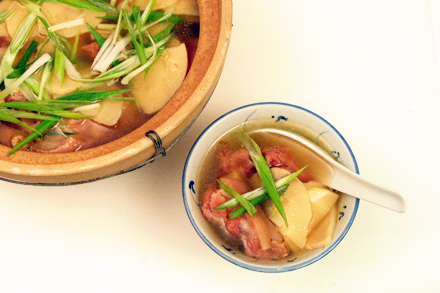
 “Last Winter Bamboo of the Season!” proclaimed the sign I saw last weekend in front of the Hong Kong Market on Hester Street in Chinatown. This would be the last shipment from China for this year’s winter bamboo crop. I was immediately reminded of a winter soup I fell in love with when I was working in Shanghai. It is called “Yan Du Xian” (腌篤鮮), a simple, hearty, quintessentially Shanghainese soup made from a duo of cured pork and fresh pork plus fresh winter bamboo shoots (冬筍).

 I was encouraged, actually prodded, to start blogging about my cooking slightly over a year ago after Kim at


 In most Asian household fish paste is normally bought from the fishmongers because it is presumed to be a laborious proposition to make at home. In fact there are many specialty stores in Asian cities offering only fish paste and fish balls. These stores are often known for their own signature variety of fish paste or fish balls. But it’s surprising to know how easy it is to make fish paste at home.
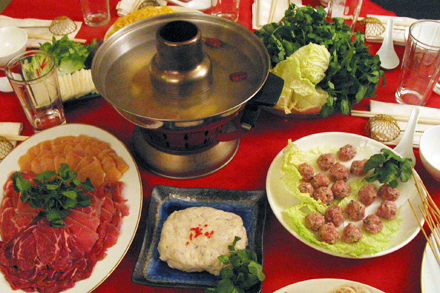
 “What? No red cooked pork?” was the astonished question from my nieces when I told them our Chinese New Year celebration this year was to be a hot pot feast. For years I’ve always made a banquet of traditional Chinese food for the obligatory New Year’s Eve reunion dinner. But this year I decided to break from our family tradition. New Year hot pot dinners have always been very common in the provincial districts of China. But many city folks are rediscovering this tradition because not only is it delicious, it is also more economical and less time consuming to prepare.
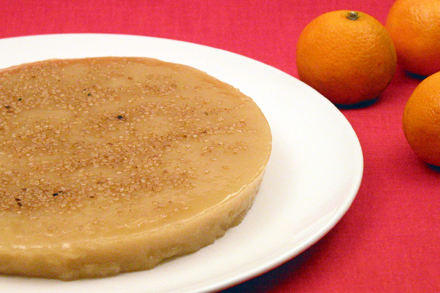
 In America homophones are language oddities that spark interest only as intellectual curiosities. But in Chinese culture they play a very large role in everyday and holiday symbols. Perhaps this is because there are so many homophones in the Chinese language. So it is that many food traditions during Chinese New Year are connected to play on homophones. One such food symbol is the Chinese New Year cake known as “nian gao” (年糕) in Mandarin.

 Red wine and Chinese food are often thought to be incompatible. Many feel that full-bodied red wines either compete aggressively with spicy Chinese dishes or simply overwhelm them. If my dinners are any indication, this is very much the case. So when I planned the long distance wine pairing with Kirstin of Vin de la Table I decided to see if I could finally find a red wine to match spicy Chinese food.

 It all started with a cheery comment on my very first Chinese food and wine pairing post back in July. Kirstin, who lives in California and writes the blog
