Posts built around cooking a dish.
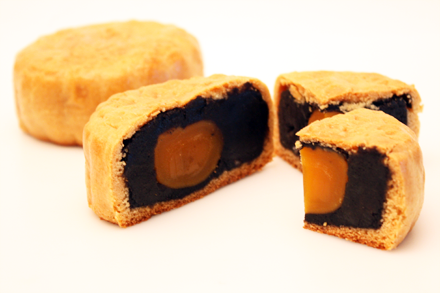
Two weeks ago a Chowhound forum user, Gordon Wong, started a discussion thread and he questioned whether mooncake is like fruitcake: often gifted but rarely eaten. I was pleased to read that majority of the responders reported they love mooncake and do eat them. I too am a fan of mooncake. I like them so much that I often wait until after the Mid-Autumn Festival so I can buy more of them at a discount.
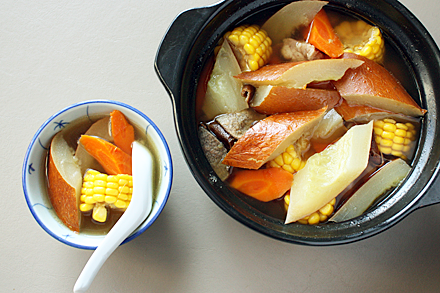
Cucumbers are known as “yellow gourds” (黃瓜) in Chinese. They are sometime also called “baby yellow gourds” (小黃瓜). I've always wondered why they’re called “yellow” since cucumbers are obviously green. Even with all the different varieties, they are all still green. But a few years ago while having dinner at a relative’s home in Hong Kong, her cook served a soup made with a wrinkly yellow-brown skinned gourd with slightly green flesh that she announced was mature cucumbers. That's when I realized why cucumbers are called “yellow gourd.” They turn into a yellowish gourd with tough dry skin when mature.
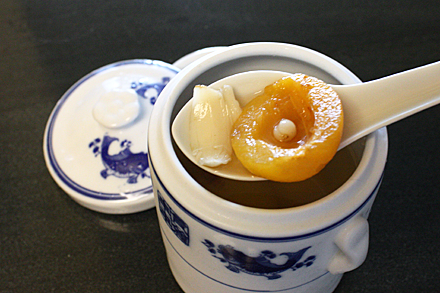
For much of May I suffered from a seemingly endless fit of coughing. This lingering dry cough from a cold has no phlegm but was irritating nevertheless. I went to see my doctor and I was given an unusual prescription with a drawing and instructions. The drawing was of a pear with hollowed center and flames at the bottom. The instructions told me to get some chuanbei (川貝) from a Chinese herbal pharmacy, place it in the cavity of the pear along with some rock sugar, then steam the pear for about 30 to 45 minutes. I followed these instructions and consumed a steamed pear a day for about one week. Miraculously I was rid of the nagging cough.
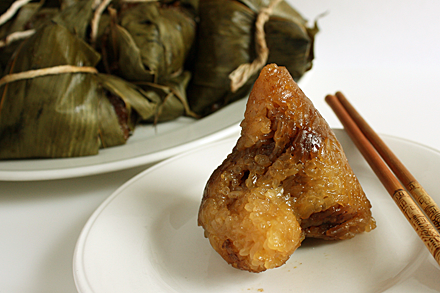
About two years ago two neighbors of ours separately stopped us in the corridor and wondered if we had a good time smoking pot in our apartment the night before. I was initially perplexed and rather indignant by the insinuation. Then I realized the odor they smelled through our door was in fact from boiling zongzi, which I was preparing for the annual Duanwu Festival, commonly called the Dragon Boat Festival in the West. The concoction of bamboo leaves, meat and spices has an odor very similar to marijuana smoke, or so I’ve been told.
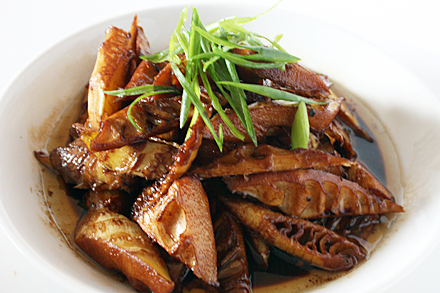
A Chinese children fable called “Spring Bamboo Shoot and the Pebbles” (春筍與亂石) tells a story of a spring bamboo shoot aspiring to burst through the soil, but is halted by a group of pebbles above him. He politely asks the pebbles to let him through but to no avail. With shear determination he pushes through between the pebbles and grows out of the soil. The pebbles are so impressed that they start celebrating him as a superstar. I’m actually not quite sure what the moral of the story is. But “success through determination” is so typically Chinese and very tiger-mom like. Regardless of the moral though, the story does tell of how bamboo shoots surge forth every spring to produce one of the most delicately delicious ingredients in Chinese cooking.
My family is originally from the coastal Chinese province of Fujian. Traditionally our noodles are cooked in soup, boiled unadorned except for seasonings, or stir-fried in a wok with a thin sauce. When I was about ten years old my family went to a Cantonese dim sum house in Singapore, which at that time was an exotic excursion for a family accustomed to mostly eating Fujianese food. We were served a pan-fried noodles dish of delicious seafood vegetable sauce dripping all over thin golden brown crispy noodles. That was the beginning of my life long love affair with Hong Kong pan-fried noodles.
For millenniums the Chinese prepared their meals with the express purpose of maintaining a healthy constitution. In fact the earliest texts of Chinese cookery read more like a pharmacologist’s guide than recipe book. It is not surprising that this practice has become a formalized discipline known as food therapy, and making herbal soup one of its best-developed aspects.
In 1953 Admiral Arthur W. Radford, chairman of the U.S. Joint Chiefs of Staff, visited Taiwan for talks with President Chiang Kai-Shek. The presidential palace chef, Peng Chang-Kuei (彭長貴), was asked to create a banquet to entertain the illustrious guest. After planning some traditional Hunan dishes, he decided to create a few new dishes for the menu. One of them was General Tso’s Chicken. Thus the world’s most famous Chinese dish was born.
Writing a book is a fulltime job. This I discovered last fall once I started to earnestly concentrate on completing my cookbook. What with my commitments in restaurant consulting and teaching, I have no time at all to prepare lunch. To utilize my time efficiently I buy commercial cold cuts, sliced cheeses and wheat bread to make sandwiches. But I yearn for the occasional comfort Chinese lunch that invariably sooths my anxiety about writing the book. So I need a new lunch plan.
If you feel that this has been a very hot summer then you’re right. In fact this last twelve-month period is the warmest ever recorded in the U.S. according to the National Oceanic and Atmospheric Administration. To escape the heat of July and August, residents of overcrowded cities throughout the Northern hemisphere abandon their homes and flock to the nearest beach resorts. Over the last several years something else has been gathering to welcome the tourists: the jellyfish.