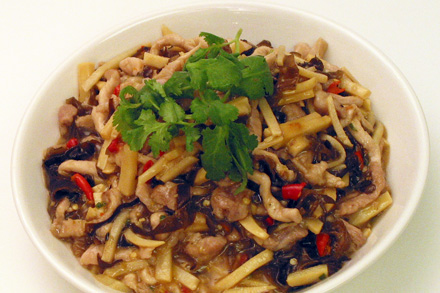
As an open-minded omnivore, I enjoy vegetarian dishes as much as meat dishes. On many occasions I’ve successfully made vegetarian dishes for my vegetarian friends. Many were surprised at the diversity of Chinese vegetarian dishes and commented how flavorful and hearty they were. The key to a rich tasty vegetarian dish is to make use of what is known as umami, which is a Japanese word used to express the fifth taste in addition to the generally accepted four tastes of sweet, salty, sour and bitter. In Chinese umami is known as xian (鮮) and making stock full of umami is the basis for a successful vegetarian dish.
Last Wednesday The New York Times published an article by Kim Severson about “Recipe Deal Breakers.” In it she asked if there is an ingredient or a technique that would stop you from using a recipe. The article was humorous and light-hearted, which I enjoyed immensely. However, that didn’t stop a firestorm of reactions from spreading all over the culinary blogosphere. Michael Ruhlman joined in the fray with his blog post the next day. Kate Hopkins at Accidental Hedonist continued the discussion with a poll. Now it’s my turn to ask a similar question. What is a deal breaker for creating authentic Chinese food in an American Kitchen?
Many Chinese vegetables are known to Americans as bok choy or simply Chinese cabbage. Although there is a wide variety of these “Chinese cabbages,” they all have a very similar, neutral, non-threatening taste recognizable to the American palate. But don’t be fooled, not all Chinese vegetables are bland and blah. There is also a large selection of mustard greens, not commonly known by Americans, that have much more distinct bitter and spicy flavors.
A month after I started my blog Bev Sansom posted a comment wanting to know how Asian stocks are made. I was pleased to know that readers like Bev are interested in proper cooking techniques.
It is an invaluable tool in a Chinese kitchen: a plate lifter. Steaming is one of the most common techniques in Chinese cooking. A plate or a bowl is often buried deep in a steamer to cook food. This tool can safely lift a hot container out of the steamer without burning your hands.
In this Wednesday’s New York Times Food and Wine section Mark Bittman presented a stir-fry dish using fermented black beans (or douchi 豆豉). What a refreshing surprise it was to see such an esoteric ingredient presented in the mainstream media. I applaud Bittman for introducing this ingredient to his readers. It gives me an opportunity to expand on the information about fermented black beans and their uses.
I was living in Boston in the 1970’s when there was a sudden craze for dry wok stir-fry. I didn’t quite understand how the Boston public became such sudden converts of dry wok stir-fry. Possibly it was the result of a very aggressive marketing campaign by a certain Chinese restaurant in Brookline Village then known as Hunan Wok. Dry wok stir-fry was touted as a “healthy choice” just when people were becoming aware of the importance of eating right. Personally I think it is not just the technique but also the selection of fresh ingredients, and vigilant use of healthful oil and sauces that make stir-fry a wholesome cooking choice. In this conclusion of the stir-fry series let me show you why dry wok stir-fry should be part of your regular cooking repertoire.
I have a wooden bowl I use to hold potatoes, onions and garlic. It sits at the end of my kitchen counter and normally does a very good job of keeping the root vegetables dry and firm. Perhaps because of the warm weather of late some of the garlic bulbs started sending out green shoots. I decided to put the bulbs in a small shallow bowl with water, and placed it in front of a very sunny window in the living room. I am in fact very proud of how the shoots are beginning to grow into beautiful greens.
If plain stir-fry is the least known stir-fry variation in America, then moist stir-fry is the best known. The gooey, tasteless sauces in “Chop Suey” and Moo Goo Gai Pan found in so many Chinese-American restaurants all rely on this technique. Whoever created these recipes obviously had a special affinity for this common technique and used it ad nauseum.
We take for granted that stir-frying is just combining a bunch of ingredients, frying them in a wok, and seasoning them appropriately; that is partially accurate. What is rarely understood is that there are variations in stir-frying technique. Broadly classified the variations are 1) plain stir-fry (清炒 or QingChao), 2) moist stir-fry (滑炒 or HuaChao) and 3) dry wok stir-fry (煸炒 or BianChao). In this third part of Stir-fry Fortnight series post let me show you how simple it is to make plain vegetable stir-fry.


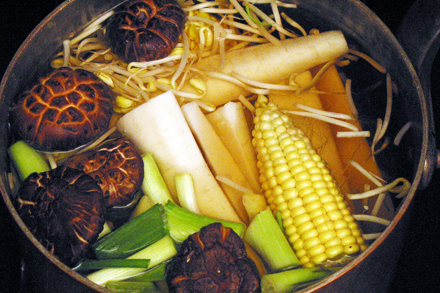
 As an open-minded omnivore, I enjoy vegetarian dishes as much as meat dishes. On many occasions I’ve successfully made vegetarian dishes for my vegetarian friends. Many were surprised at the diversity of Chinese vegetarian dishes and commented how flavorful and hearty they were. The key to a rich tasty vegetarian dish is to make use of what is known as umami, which is a Japanese word used to express the fifth taste in addition to the generally accepted four tastes of sweet, salty, sour and bitter. In Chinese umami is known as xian (鮮) and making stock full of umami is the basis for a successful vegetarian dish.


 A month after I started my blog Bev Sansom posted

 It is an invaluable tool in a Chinese kitchen: a plate lifter. Steaming is one of the most common techniques in Chinese cooking. A plate or a bowl is often buried deep in a steamer to cook food. This tool can safely lift a hot container out of the steamer without burning your hands.


 I have a wooden bowl I use to hold potatoes, onions and garlic. It sits at the end of my kitchen counter and normally does a very good job of keeping the root vegetables dry and firm. Perhaps because of the warm weather of late some of the garlic bulbs started sending out green shoots. I decided to put the bulbs in a small shallow bowl with water, and placed it in front of a very sunny window in the living room. I am in fact very proud of how the shoots are beginning to grow into beautiful greens.